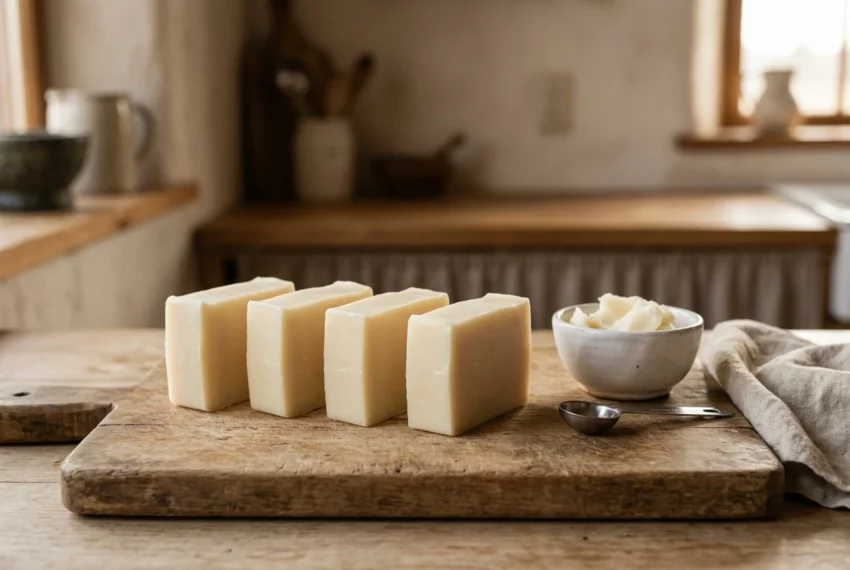
Tallow makes one of the oldest soaps there is: a hard, white, mild bar with a creamy lather. This tallow soap recipe uses three fats, one lye solution and no extras you need to hunt down. It also covers what changes when you work with rendered beef fat, from melting and trace to cure time.
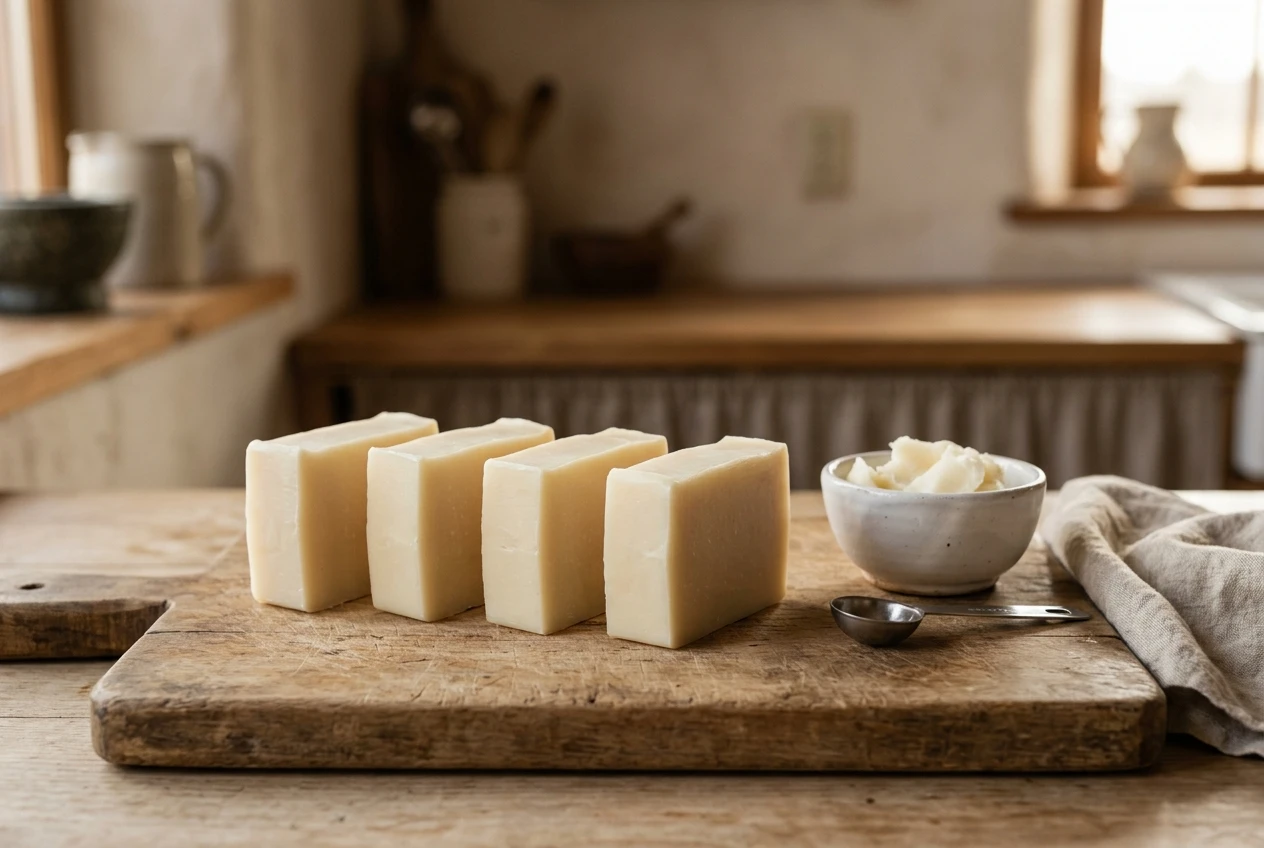
Why Tallow Makes a Hard, Creamy, Long-Lasting Bar
Tallow is mostly saturated fat, which is solid at room temperature. In soap, that translates to a firm bar that holds its shape in the shower and wears down slowly. It also produces a dense, creamy lather rather than big airy bubbles.
Tallow on its own can feel a little waxy and does not lather quickly. That is why most tallow soap recipes pair it with a softer liquid oil like olive and a bubbly fat like coconut. The blend below keeps the hardness of tallow and fixes its weak points.
Other practical points in its favor:
- Unscented tallow bars are plain and mild, which suits people who prefer simple ingredient lists.
- The bar unmolds cleanly and cuts without crumbling when the batch is made correctly.
- A single fat can be rendered at home or bought already rendered, so it is easy to source.
Ingredients and Equipment for Tallow Soap
This is a 1,000 gram oil batch, which makes roughly eight to ten bars depending on your mold:
- 600 g rendered beef tallow (60%)
- 250 g olive oil (25%)
- 150 g coconut oil (15%)
- Sodium hydroxide (lye) and distilled water, in amounts from a lye calculator (see the next section)
- Optional: essential oil, natural colorant, or an additive
Use fully rendered, filtered tallow. Fat with leftover bits of meat or moisture smells stronger and can spoil faster in the finished bar. To render your own, melt trimmed fat slowly on low heat, strain it through fine cloth or a coffee filter, and let it set before weighing.
Equipment:
- A digital scale that reads to the gram
- Heat-safe stainless steel or heavy plastic containers (never aluminum, which reacts with lye)
- A stick blender and a silicone spatula
- Safety goggles, long sleeves and chemical-resistant gloves
- A silicone or lined wooden mold
- A thermometer
How to Build and Check Your Recipe in a Lye Calculator
Every oil needs a different amount of lye to turn into soap, so the lye weight comes from a calculator and nowhere else. Do not copy lye numbers from a blog post, including this one.
Enter the three oil weights above, choose sodium hydroxide, and set the superfat to 5%. A 5% superfat leaves a small share of the oils unsaponified, so the bar is gentler on skin and leaves a margin for small measuring errors. Use the calculator’s standard water setting, then write down the lye and water weights it gives you.
Before you move on, check three things:
- The oil names match what you actually have (tallow, olive, coconut).
- The total oil weight in the calculator equals what you plan to weigh out.
- The result looks sensible when you run it in a second calculator. Small differences between tools are normal, but a big gap means a typo somewhere.
Change the fat percentages and you must run the numbers again. Your final recipe is only safe once the calculator has seen the exact weights you will use.
Cold Process Tallow Soap, Step by Step
- Gear up. Put on goggles, gloves and long sleeves, open a window, and clear the counter of pets and children.
- Weigh the lye and water separately. Use the figures from your calculator.
- Make the lye solution. Pour the lye into the water, never the reverse, and stir until it clears. It will heat up and give off fumes, so do not lean over it. Set it somewhere safe to cool.
- Melt the fats. Melt the tallow and coconut oil together on low heat, then add the olive oil. Everything should be fully liquid with no solid flecks.
- Check temperatures. Let the oils and lye solution come down to about the same temperature, ideally somewhere between body warmth and 120°F (49°C).
- Combine. Pour the lye solution into the oils down the shaft of the stick blender to limit splashing.
- Blend to trace. Pulse and stir until the mixture looks like thin pudding.
- Add extras. Stir in any scent or color at light trace.
- Pour and insulate. Pour into the mold, cover, and wrap in a towel for 24 hours so the soap goes through gel phase evenly.
- Unmold and cut once the bar is firm, usually after one to two days.
Melting Tallow and Reaching Trace Without Surprises
Tallow starts to firm up as it cools, and that causes most beginner trouble. If the oils sit at room temperature while you wait on the lye, the tallow can begin to set again, and the batter can thicken fast or look lumpy.
Two habits prevent this. First, melt the fats completely and keep them just warm, not hot. Second, do not let the lye solution and oils drift apart in temperature: if the lye is much cooler than the oils, small solid bits of fat can form on contact.
Tallow-heavy batters also tend to trace faster than recipes built on olive oil alone. Blend in short bursts and stop when the batter leaves a faint trail across the surface. If you are unsure what that looks like, our guide to what trace is in soap making shows the stages. Pouring at thin trace gives you time to scrape the pot and tap out air bubbles before the batter sets.
Scenting and Coloring a Tallow Bar Naturally
Tallow soap is naturally off-white, so it takes color softly. Clays, herbs and spices give gentle tints, and our post on using natural colors in soap making covers which ones hold up in lye. Test small amounts first, because the same powder can look quite different in a tallow batter than in one based on olive oil.
For fragrance, essential oils work well and need to stay within safe skin limits. Check usage rates in the essential oil dilution chart before you measure. Citrus and mint scents tend to fade in cold process, so use a light hand and expect a subtle result.
If you want texture or skin-feel extras like oatmeal, milk or sugar, the soap additives guide explains how each one behaves. Sugar and milk raise the batch temperature, which matters in a recipe that already moves quickly.
Can You Make Tallow Soap With Melt and Pour?
Not from scratch. Melt and pour base is soap that has already been made, so you cannot stir raw tallow into it and get a tallow soap. The fat needs lye to become soap, and melt and pour skips that step for you.
What you can do is choose a base made with tallow. Some suppliers sell tallow-based melt and pour, so read the ingredient list for tallow or sodium tallowate. Then the process is simple:
- Cut the base into small cubes.
- Melt it in short bursts in the microwave or in a double boiler, stirring between bursts.
- Stir in a small amount of scent or color once it is liquid.
- Pour into the mold and let it set until firm.
This route skips handling lye and is a good way to try a tallow bar before committing to a full batch. The trade-off is less control over the oils, and you cannot adjust the recipe, since the soap was made by someone else.
Cure, Test and Store Your Bars
Cold process tallow bars feel hard within a day or two, but they still need time to finish saponifying and lose water. Leave them on a rack with air moving around every side. A longer cure gives a milder, harder bar, and our soap curing guide explains how to judge when yours is ready.
Do a simple check before you use or gift a bar. Wet it, lather it and wash your hands. If the skin feels tight, stingy or burning, the bar is not ready or the recipe was off. Stop using it and look back at your calculator numbers.
Store finished bars somewhere cool, dry and dark. Tallow is a stable fat, but any soap can develop small orange spots if the oils go off, so do not seal bars in airtight plastic while they are still curing.
Fixing Common Tallow Soap Problems
- Grainy or lumpy batter: The fats cooled too far before mixing. Next time keep the oils warm and match the lye temperature.
- Batter thickened before pouring: Tallow batters move quickly. Blend in short pulses and pour at thin trace.
- Soft bars that will not unmold: Check that the weights matched your calculator and that you did not substitute oils without recalculating. Give the bars more time in the mold.
- White powder on top: This is soda ash, which forms when the surface reacts with air. It is harmless and washes off, and covering the mold right after pouring helps.
- Dry, tight feeling after washing: The superfat may be too low or the bar too young. Cure longer, or recalculate with a slightly higher superfat.
- Spots appearing in storage: Check that the tallow was fully rendered and filtered, and that bars are kept dry.
If a bar smells or feels wrong and you cannot trace the cause, it is safer to discard it than to use it on skin.
Before You Pour Your First Batch
Before you pour your first batch, run your own oil weights through a lye calculator and double-check the numbers. Our guide on using a soap lye calculator safely walks you through it.
Important Note:
This information is for educational purposes only.
This post may contain affiliate links. If you make a purchase through these links, I may earn a small commission at no extra cost to you.
© 2026, Tes. All rights reserved.